

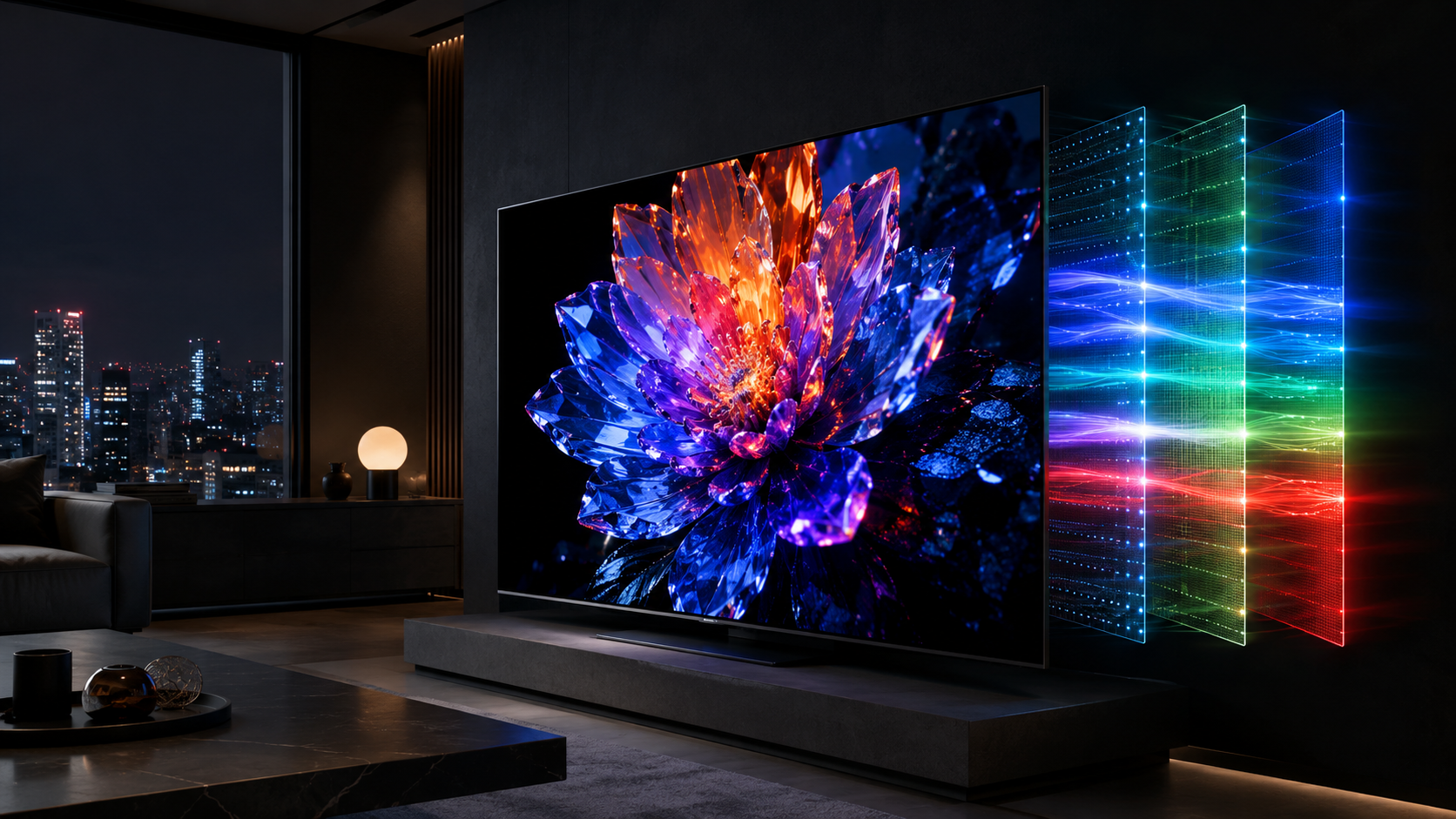
The OLED TV market is evolving very rapidly. Just a few years ago, choosing a TV meant deciding between OLED or LCD. Today, customers may encounter designations such as OLED, OLED+, WOLED, QD-OLED, Primary RGB Tandem OLED, Primary RGB Tandem 2.0, or Tandem WOLED. It sounds complicated, but the differences can be explained without delving into laboratory details.
One of the most important changes in the latest generation of premium TVs is Primary RGB Tandem OLED. This technology advances the design of WOLED panels to increase their brightness potential, light efficiency, and HDR image quality. In the 2026 generation, LG Display refers to it as Primary RGB Tandem 2.0 within the Tandem WOLED family. Such panels are featured in models available in the Prestige TV catalog, such as the Philips OLED+911 and Philips OLED+951.
Is Primary RGB Tandem OLED better than QD-OLED? Is it worth paying extra for the latest generation? And does the "RGB" label mean it is a completely different technology than current OLED? Below, we explain the most important differences from the perspective of someone buying a TV.
What is Tandem OLED?
Let’s start with the most important point: Primary RGB Tandem OLED is still an OLED TV. It is not a technology that competes with OLED as a whole category. Similarly, QD-OLED also belongs to the OLED display family. The difference lies in how the panel produces and uses light and how the colors visible on the screen are created.
In every OLED TV, pixels are self-emissive. This means they do not need separate LED backlighting placed behind the screen, as is the case in LCD TVs. Individual pixels can dim independently, allowing OLED to achieve very deep blacks and high contrast even in difficult scenes, such as a night sky, subtitles on a black background, or bright lights on a dark image.
The term "Tandem" refers to the use of multiple OLED emissive layers working together. The goal is to obtain more light and better efficiency than in older designs. Therefore, the name Tandem OLED should not be interpreted as an additional backlight or a second panel. Everything still happens within the structure of a self-emissive OLED screen.
It is also worth remembering that the word "Tandem" alone no longer defines one specific family of panels. Therefore, when purchasing, the full name of the technology, e.g., Primary RGB Tandem 2.0 WOLED, is what matters most.
How does Primary RGB Tandem OLED work?
From early WOLED to a four-layer design
In large WOLED panels, the light generated in the emissive stack is used to obtain an image in a layout characteristic of this family of screens. One of the most important directions in technology development has been increasing brightness without sacrificing the advantages of OLED.
In the fourth generation of OLED panels presented by LG Display in 2025, the Primary RGB Tandem solution was applied. Instead of the previous three-layer design, the manufacturer used a layout where light sources are separated into successive layers. In practice, we have a four-layer structure using two blue layers and independent layers responsible for red and green.
This allows the panel to generate light more efficiently and achieve higher brightness potential. For the first generation of Primary RGB Tandem, LG Display declared a maximum panel brightness of up to 4000 nits, higher color brightness, and improved energy efficiency compared to the previous generation.
Is Primary RGB Tandem a "true RGB OLED"?
This is one of the most important things to know before buying. The name Primary RGB Tandem should not be understood as an indication that the TV uses a classic layout of three directly emitting red, green, and blue subpixels.
The term RGB in the name Primary RGB Tandem refers to the separation of the primary light sources in the emissive stack. The panel remains part of the WOLED family. This is significant, because online you may encounter a simplification suggesting that "Primary RGB Tandem" means a shift from WOLED to a completely new, direct RGB OLED. Such a representation of the technology would be misleading.
Primary RGB Tandem 2.0 and Tandem WOLED – what changes in the 2026 generation?
In 2026, LG Display began using the name Tandem WOLED more broadly, and the development of the emissive technology was given the designation Primary RGB Tandem 2.0. The latest design still uses a four-layer architecture but has been further optimized for pixel structure, panel control, and efficiency.
For the reference Tandem WOLED panel for 2026, LG Display specifies a maximum brightness of up to 4500 nits, 99.5% coverage of the DCI-P3 space, a refresh rate of up to 165 Hz, and a very low level of reflectance due to an anti-reflective layer. The technology is present in panels from 48 to 83 inches, although the parameters of a specific TV depend on how the manufacturer uses the panel.
4500 nits – what does this number really mean?
It is worth stopping at this parameter, as it is easy to misinterpret. 4500 nits does not mean that the entire TV screen constantly glows at 4500 nits during a movie or a match.
LG Display specifies the maximum value for measurement conditions including 3% APL, which is a very small bright part of the image. This parameter primarily shows the panel's potential for very intense HDR point lights. These can be a reflection of the sun, a flash of metal, a neon sign, an explosion, or a small light source in a dark scene.
TP Vision, upon presenting META 4.0 Primary RGB Tandem 2.0 panels in Philips OLED+ TVs, simultaneously stated up to 4500 nits of peak brightness and about 400 nits for a full white screen. This is a good example showing how much the measurement of a small HDR area differs from the brightness of the entire matrix surface.
Therefore, when comparing TVs, it is not worth basing the decision solely on the highest number written in the specification. What also counts are HDR tone mapping algorithms, the image processor, heat dissipation, the set image mode, the size of the bright fragment of the scene, and how a given manufacturer controls the panel.
Primary RGB Tandem OLED vs classic OLED and QD-OLED
The table below shows the most important differences from the user's perspective. The term "OLED without Primary RGB Tandem" is a practical category here, not the name of one specific panel design. Individual generations of standard OLED TVs can significantly differ in brightness and capabilities.
| Feature | OLED without Primary RGB Tandem | Primary RGB Tandem 2.0 / Tandem WOLED | QD-OLED |
|---|---|---|---|
| Technology family | OLED | OLED / WOLED | OLED |
| How the image is created | Self-emissive OLED pixels; construction depends on the panel used | Multilayer emissive stack with independent R, G, and B sources in a Primary RGB Tandem structure | Blue OLED source and a quantum dot layer converting light to obtain colors |
| Blacks and contrast | Very high level thanks to self-emissive pixels | Very high level thanks to self-emissive pixels | Very high level thanks to self-emissive pixels |
| HDR brightness potential | Dependent on generation and specific TV | Very high in the latest generation; especially for small HDR lights | High; the strength is also the brightness and purity of saturated colors |
| Colors | Very good, depending on panel and processor | Very wide color gamut; panel manufacturer specifies up to 99.5% DCI-P3 for the 2026 generation | Very high color purity and wide color volume thanks to Quantum Dot conversion |
| Bright room | Depends heavily on the brightness and coating of the specific model | The latest generation puts a strong emphasis on high brightness and reducing reflections | Many models offer high brightness; type of screen surface depends on the specific TV |
| Viewing angles | Very good | Very good | Very good; wide angles are one of the strengths of QD-OLED |
| Gaming | OLED provides a very fast response time; refresh rate depends on the model | Up to 165 Hz in selected models | Up to 165 Hz in selected models |
| Example from Prestige TV | Philips OLED820 | Philips OLED+911, Philips OLED+951 | Samsung S95F 55", Sony BRAVIA 8 II 55" |
The biggest difference: how color is created
QD-OLED uses blue OLED light as a source, and then quantum dots allow for very pure red and green. Thanks to this, the technology performs particularly well with intense, saturated colors at high brightness.
Primary RGB Tandem 2.0 develops a different path. It increases the potential of the WOLED design through a more advanced emissive stack and improvements to the entire panel. The result is a very high potential HDR brightness while maintaining the characteristic advantages of OLED.
However, this does not mean that one technology is unconditionally better. A good TV is a combination of the panel, image processor, HDR algorithms, screen coating, electronics, Smart TV system, and additional features.
What will you actually see while watching?
Movies in the evening
In a darkened living room, all modern variants of OLED can provide an excellent effect. Deep blacks, precise light control at the level of individual pixels, and the lack of backlight blooming typical of LCDs make OLED very well-suited for home cinema.
Under such conditions, the advantage resulting solely from maximum brightness will be less significant than the quality of shadow detail reproduction, HDR tone mapping, the set image mode, and the source quality.
HDR and very bright effects
Here, the potential of the latest Primary RGB Tandem becomes more visible. Higher light-generating capacity allows for stronger point reflections and increases the difference between dark and very bright elements of a scene.
QD-OLED, on the other hand, has a natural design advantage in reproducing very pure, saturated colors, which is why colorful neon signs, games, animations, and HDR materials using intense red, green, or blue can look particularly effective.
Watching in a bright living room
In a sunny room, it is not enough to look at the word OLED alone. Both the TV's brightness and the screen surface and the way it handles reflections are very important.
Primary RGB Tandem 2.0 was developed with a strong emphasis on high brightness and a very low level of reflectance. However, this does not mean that every TV with a different OLED variant will be weak during the day. For example, the Samsung S95F in the Prestige TV catalog uses QD-OLED and a matte screen surface.
Sports
For sports, more counts than the type of panel. Motion fluidity, processing of lower-quality broadcast material, image scaling, and how the TV behaves when displaying large bright surfaces, such as grass or ice, are important.
Therefore, a customer who watches sports primarily should compare specific models rather than choosing solely based on the Primary RGB Tandem or QD-OLED label.
Consoles and computers
OLED is a very good choice for gamers due to the fast pixel response time and the ability to achieve high refresh rates. However, here too, the panel technology does not answer all the questions.
Before buying, it is worth checking the number of appropriate HDMI 2.1 inputs in a specific model, supported VRR variants, maximum refresh rate, game mode, and HDR formats. For example, the Philips OLED+911 and Samsung S95F 55" in the Prestige TV catalog offer refresh rates up to 165 Hz, while the Sony BRAVIA 8 II 55" is a 120 Hz model.
Primary RGB Tandem, QD-OLED, and OLED – example models from the Prestige TV offer
The panel technology itself is only part of a TV. Therefore, it is best to compare it using the example of specific devices present in the Prestige TV catalog.
Philips OLED+911 – Primary RGB Tandem 2.0
Philips OLED+911 uses a Primary RGB Tandem 2.0 OLED+ panel with a refresh rate of up to 165 Hz. The manufacturer combines it with the 10th-generation P5 Perfect Picture Engine with AI, four-sided Ambilight, Titan OS, Dolby Vision 2 Max, and a Bowers & Wilkins 3.1 sound system.
This is a proposal for a customer who is looking not only for the latest panel generation but also for an extensive, complete premium TV with a strong emphasis on image, sound, and Ambilight.
Philips OLED+951 – flagship Primary RGB Tandem 2.0
Philips OLED+951 is positioned even higher in the range. The model uses a META 4.0 Primary RGB Tandem 2.0 WOLED, a refresh rate of up to 165 Hz, and the 10th-generation P5 AI Dual Engine processor. Its Prestige TV product card also includes Dolby Vision 2 Max, four-sided Ambilight, and Titan OS.
This is an example of a TV where the new matrix is combined with flagship image processing. This is significant because, especially with HDR materials, the panel's potential alone is not enough — the processor must properly utilize its brightness range.
Samsung S95F – QD-OLED
Samsung S95F 55" represents a different path of OLED development. In this version, it uses a QD-OLED panel, a refresh rate of up to 165 Hz, the NQ4 AI Gen3 processor, the Tizen system, an external One Connect module, and a matte screen surface.
This is an interesting alternative to Primary RGB Tandem, especially for a person who values the capabilities of QD-OLED in terms of saturated colors, high refresh rates, and the Samsung ecosystem.
Sony BRAVIA 8 II – QD-OLED with Sony's approach to imaging
Sony BRAVIA 8 II K-55XR8M2 also uses QD-OLED, but shows why two TVs with a similar panel family do not have to be the same products. The model combines a 120 Hz QD-OLED panel with the XR processor, Google TV system, and Dolby Vision support.
This is also a good example showing that HDR formats do not automatically follow from the type of matrix. Their support is decided by the specific television manufacturer.
Philips OLED820 – OLED without the Primary RGB Tandem designation
The latest technology does not always have to be the most rational choice for every customer. The Philips OLED820 is an example of an OLED TV that the Prestige TV product page does not define as Primary RGB Tandem. The model offers features such as 4K OLED, a refresh rate of up to 144 Hz, Google TV, three-sided Ambilight, and support for Dolby Vision and HDR10+ Adaptive.
For someone who primarily watches movies in the evening and wants to enjoy the benefits of OLED without needing the current top-tier panel class, such a model may turn out to be a more cost-effective choice.
More models can be compared in the OLED TVs at Prestige TV category.
Primary RGB Tandem or QD-OLED – which TV to choose?
Primary RGB Tandem 2.0 is worth considering when...
You are looking for the most advanced premium OLED TV possible, you watch a lot of HDR content, the TV will be in a bright room, or you care about strong, point-source light effects. The latest Tandem WOLED also makes sense if you want to buy a TV for several years and care about having the current generation of panel technology.
QD-OLED is worth considering when...
You prioritize highly saturated colors, a wide color gamut, and impressive HDR. QD-OLED can be an attractive choice for both movies and games, but the final performance is always determined by the specific TV itself. The Samsung S95F and Sony BRAVIA 8 II show how different two products using the same family of screen technology can be.
An OLED without the latest Tandem is worth considering when...
You primarily want to achieve the black levels, excellent contrast, and fast response times characteristic of OLED, but you also have a reasonable budget. For evening movie sessions, the difference between a good OLED and the most expensive model may be less important to some users than the difference in price, screen size, or features.
Do not choose a TV solely based on the matrix
The type of panel is a very important parameter, but it should not be the only one. Before purchasing, also check:
- the screen size appropriate for your viewing distance,
- the processor and image processing quality,
- supported HDR formats,
- the number and capabilities of HDMI ports,
- the refresh rate and features for gamers,
- the screen surface and performance in a bright room,
- the Smart TV system,
- the quality of the built-in sound,
- mounting conditions and placement of the TV in the room.
What about OLED burn-in?
Primary RGB Tandem still uses organic OLED technology, so it should not be treated as a screen completely immune to burn-in. The risk primarily concerns the long-term, repetitive display of the same static elements, such as news tickers, logos, app interfaces, or HUD elements in games.
Modern OLED TVs use various protective mechanisms, including pixel shifting, periodic panel refreshing procedures, and limiting the brightness of selected static elements. For normal, varied home viewing, there is no reason to give up on OLED solely out of fear of this phenomenon, but for non-standard use—such as displaying a single static image for many hours every day—it is worth discussing how you intend to use the TV before purchasing.
The best OLED is a model matched to the room and viewing habits
There is no single TV that is best for everyone. Someone watching movies in the evening needs a different model than a gamer using a PC and console, or a customer with a large, very bright living room.
If you are not sure whether Primary RGB Tandem, QD-OLED, or another OLED would be better for you, take advantage of professional advice from Prestige TV. When choosing, you can consider not only your budget but also the distance from the screen, room lighting, the content you watch, and your requirements regarding consoles, sound, and the Smart TV system.
After purchase, it is also worth checking information on TV calibration and delivery and professional installation. Correct image setting is particularly important in premium TVs because it allows you to utilize the panel's capabilities without excessive brightness, color temperature, or artificial sharpening.
See the OLED TVs available in the Prestige TV catalog or contact Prestige TV to select a model for your living room.
FAQ – frequently asked questions about Primary RGB Tandem OLED
What is Primary RGB Tandem OLED?
Primary RGB Tandem OLED is a development of WOLED panels using a multi-layer emissive stack with separated RGB light sources. In the 2026 generation, the solution is being developed as Primary RGB Tandem 2.0 in Tandem WOLED panels.
Is Primary RGB Tandem OLED a direct RGB OLED?
No. The name "Primary RGB" refers to the construction of the panel's emissive layers, not a simple arrangement of three direct RGB subpixels. The technology used in large TVs remains part of the WOLED family.
Is Primary RGB Tandem OLED better than QD-OLED?
There is no universal winner. Primary RGB Tandem 2.0 offers very high brightness potential and advanced anti-reflective technology, while QD-OLED stands out for its high purity and wide range of saturated colors. Image quality is also determined by the construction of the specific TV and its processor.
Does 4500 nits mean the TV constantly reaches that brightness?
No. 4500 nits is the maximum value declared for the panel under specific conditions and with a small, bright portion of the image. This is not the brightness of the entire screen during normal viewing.
Can Primary RGB Tandem OLED burn in?
Like other OLED screens, it uses organic materials, so the possibility of permanent image retention when displaying static elements for long periods does not disappear. However, modern OLED TVs use a range of panel protection mechanisms to limit this risk.
Which TVs at Prestige TV use Primary RGB Tandem 2.0?
In the current Prestige TV catalog, Primary RGB Tandem 2.0 technology is used in, among others, the Philips OLED+911 and Philips OLED+951 TVs. Current screen size variants and availability should be checked directly on the product pages.
Summary
Primary RGB Tandem OLED is one of the most important evolutions of modern WOLED, not a complete departure from OLED technology. The multi-layer design has allowed for a significant increase in brightness potential, and the latest Primary RGB Tandem 2.0 further improves efficiency, color reproduction, and anti-reflective properties.
QD-OLED achieves a similar goal through a different path—it uses a blue OLED source and quantum dots to achieve very pure colors. Both technologies can provide premium-class images, and both have their strengths.
Therefore, instead of asking only "Primary RGB Tandem or QD-OLED?", it is better to answer: what kind of room will the TV work in, what content do you watch, what screen size do you need, and which features are truly important to you?
Check the current offer of OLED TVs at Prestige TV, and if you need help comparing specific models, use Prestige TV's professional advice.
Udostępnij:
Which 55-inch TV should I buy in 2026?