

Micro RGB Matrix – what is it, how does it work, and is it worth your interest?
Micro RGB is one of the most exciting innovations in the world of premium TVs. To many customers, it sounds futuristic, but in practice, it involves a very specific change: instead of classic, single-color backlighting, the screen uses microscopic light sources in three colors – red, green, and blue. The result? More precise light control, a wider color palette, high brightness, and an image that can make a huge impression from the very first seconds.
If you follow the latest news in the RTV world, this name is worth remembering. If, however, you are simply looking for a premium-class TV and want to understand if Micro RGB is a real advantage or just a marketing gimmick – this guide has been prepared specifically for such a reader. Below, we explain calmly, without technical chaos, what Micro RGB technology is, how it differs from OLED and Mini LED, for whom it will be the best choice, and what to look for before purchasing.
What is a Micro RGB matrix
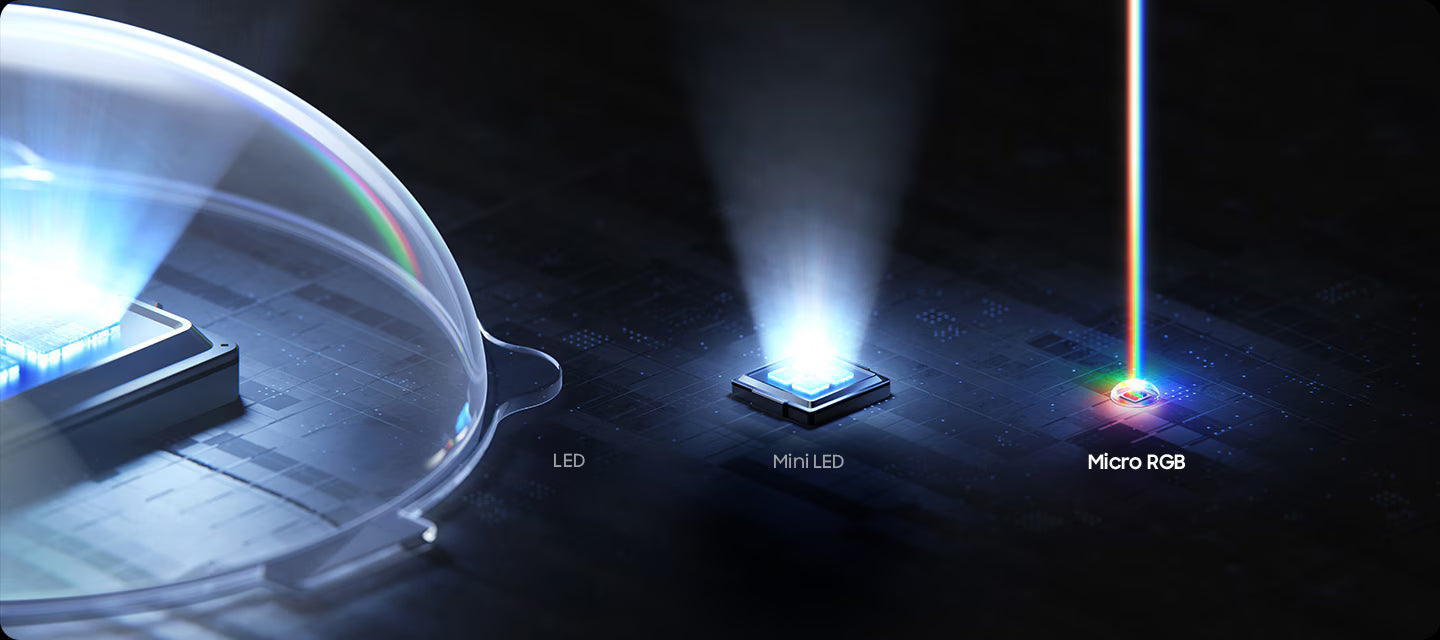
Simply put, Micro RGB is a new generation of premium LCD TVs, where very small diodes in the three primary colors: red, green, and blue, are responsible for the light. In a classic LED or Mini LED TV, we usually have white or blue backlighting that is subsequently filtered to obtain color. In Micro RGB, the color is created much closer to the light source, which is why the image can look more natural, more saturated, and "cleaner."
This is important because in premium TVs, it is less about 4K resolution itself. Today, the customer expects more: better control of bright and dark parts of the image, depth, clearer HDR, a wide color palette, fewer reflections in a bright living room, and greater comfort during movies, sports, and gaming. This is exactly where Micro RGB is meant to show its advantage.
At the same time, it is worth clarifying the terminology. Micro RGB is not the same as MicroLED. This is a very common mistake. MicroLED is a self-emissive technology where every point of the image emits light on its own. Micro RGB – at least in TVs currently available on the premium market – primarily refers to a modern RGB backlighting system behind the LCD panel. For the end customer, one thing is most important: Micro RGB is intended to be a step forward compared to classic LCD TVs, but it should not be confused with absolute direct-emission technology like OLED or MicroLED.
In the Prestige TV store, you can already see that this is not just a prototype from a trade fair. The technology has reached real product models and is starting to appear in more "home" diagonals, not just exclusively extremely large ones. If you would like to see the current offer of this class of TVs, it is worth checking out the premium TVs category or directly to selected Micro RGB models, such as the Samsung 55" Micro RGB, Samsung 65" Micro RGB, Samsung 75" Micro RGB, Samsung 65" Micro RGB Pro or Samsung 115" Micro RGB.
How Micro RGB works in practice
In everyday use, the customer does not need to know every technical detail, but it is worth understanding the principle. In a Micro RGB TV, the backlighting is created by a huge number of very small RGB diodes. Each of them can be controlled extremely precisely, and this translates into several practical benefits.
Firstly – color. Since the light source itself works in red, green, and blue, the TV has more freedom to build a wide and more precise palette. This is especially visible in HDR materials: sunsets, neon lights, concert scenes, football turf, skin tones, and lighting details, which in weaker TVs can look too flat or too aggressive.
Secondly – brightness. TVs of this type are designed to perform well not only in the evening but also in a typical living room where windows, reflections, and strong light appear during the day. This is a huge advantage for people who watch sports, news, series, and streaming platforms not only after dark, but throughout the entire day.
Thirdly – contrast control. Micro RGB does not work like OLED, where every pixel emits light independently, but thanks to more advanced light control, it can manage bright and dark zones of the image better than a classic LED TV. In practice, this means clearer details in highlights, better tonal transitions, and more orderly HDR.
Fourthly – ease of use. Modern models of this class also feature high refresh rates, advanced features for gamers, HDMI 2.1, powerful AI processors, anti-reflection technologies, and extensive audio systems. For the customer, this is important information: Micro RGB is not just a "nice matrix," but usually an element of a flagship, complete premium TV.
This is precisely why Micro RGB should be treated not as a single feature, but as an entire development direction for premium LCD TVs. For some, color will be key, for others, brightness, and for others still, gaming or a very large screen in a representative living room. The interesting thing about this technology is that it combines several needs at once.
Why this technology is generating so much interest
The reason is simple: the premium TV market has for years been looking for a solution that would take the strongest sides of modern LCD and simultaneously approach the quality of color and contrast associated with the highest shelf. OLED delights with its blacks and cinematic image character, but not every customer wants an OLED. Some watch a lot in a bright living room, others prioritize extremely large diagonals, and still others simply prefer a design without typical concerns that some users still associate with self-emissive panels.
Micro RGB enters exactly into this gap. It provides a chance for an image that is more "premium" than in a standard Mini LED, especially in color and the impression of depth, while remaining a solution that fits well with large diagonals. This is especially important today, when more and more people are switching from 55" TVs to 65", 75", 85", or even larger screens.
The second reason is the pace of development. Until recently, similar designs were shown mainly at trade fairs and in conversations about "future technology." Today, they are already available in real product series, with specific diagonals, gaming features, and premium add-ons. This is the moment when a customer can not only read about this technology, but truly consider it when buying a TV for their home.
The third reason is more practical: these TVs simply make an impression live. In the showroom, the difference is often visible faster than in the specifications. The color seems cleaner, the image more "open," the lights more orderly, and a large screen doesn't just look like a larger version of a regular LCD. This is precisely why Micro RGB may be one of those technologies that is best understood not by the description alone, but by the first direct contact.
Micro RGB vs OLED vs Mini LED
This is the most important comparison from the customer's perspective. The slogan "new technology" is not enough if you don't know what it actually changes in everyday use. The table below shows the differences in a simple, shopper-friendly way.
| Technology | How it builds an image | Strongest points | What to watch out for | For whom |
|---|---|---|---|---|
| Micro RGB | LCD panel with very precise RGB backlighting based on microscopic diodes | Very wide color palette, high brightness, great HDR potential, good conditions for large diagonals and bright living rooms | It is still not a self-emissive panel; premium segment and technology still new on the market | For those looking for novelties, a big "wow" effect, strong HDR, high brightness, and a premium-class TV |
| OLED | Each pixel glows independently | Best black, great contrast, cinematic image, wide viewing angles | In very bright rooms, not every model will be as comfortable as the best premium LCD TVs | For fans of home cinema, evening screenings, and the most "reference" movie reception |
| Mini LED | LCD panel with a large number of backlighting zones | High brightness, good quality-to-price ratio, very universal choice for the living room and sports | Color and light control are usually not as advanced as in the best Micro RGB implementations | For people who want a strong, modern premium TV, but without entering the highest level of novelty |
So if you are asking yourself: "Is Micro RGB better than OLED?" – the answer is: it depends on your priorities. For strictly cinematic screenings in a darkened room, OLED still remains the gold standard for many viewers. However, if high brightness, a representative large screen, modern design, very strong HDR, and comfort in bright rooms count, then Micro RGB becomes an extremely interesting alternative.
If you would like to compare classic technology choices, it is worth going to our related content as well: Which TV to buy in 2026, OLED TVs and Mini LED TVs.
For whom is a Micro RGB TV a good choice
- First – for the premium customer who wants to buy a TV "for years." If you are not looking for just decent 4K, but want to jump straight into one of the most interesting technologies currently being developed on the market, Micro RGB is a natural candidate.
- Second – for people watching in a bright living room. Many families use their TV mainly after work, but still in daylight, with lamps on, in an open living space, and with large glass surfaces. In such conditions, black levels alone are not the only criterion. Resistance to reflections, proper brightness, and image readability matter. This is where Micro RGB can show its very strong assets.
- Third – for lovers of large diagonals. As the screen size increases, requirements grow. For a 75", 85", or over 100" to truly delight, the TV must manage light and color well over the entire surface. Micro RGB is developed specifically with large formats and a cinematic effect at home in mind.
- Fourth – for gamers. If, besides movies and series, PS5, Xbox, or PC gaming also count, it is worth looking at models with 144 Hz or 165 Hz, HDMI 2.1, VRR, ALLM, FreeSync Premium Pro, and a good image processor. In practice, Micro RGB is currently found in models that usually already have a full package of gaming features, so you don't have to choose between a "movie TV" and a "gaming TV."
- Fifth – for people who want to see the advantage of technology with their own eyes. There are customers who do not buy according to specifications alone. They want to walk into a showroom, turn on a few HDR scenes, sports, streaming, and compare the image without rushing. Micro RGB is exactly the type of innovation that gains a lot during a live presentation.
What to look for before buying
Even the best technology does not exempt you from making a reasonable choice of a specific model. Before buying, it is worth answering a few questions.
How big a screen will really be appropriate
Micro RGB looks especially good on larger diagonals, but the size must be matched to the distance from the sofa, the layout of the living room, and the mounting method. If you are not sure whether it is better to choose a 65", 75", 85", or a larger screen, it is worth using our consulting services and comparing models live.
What content do you watch most often
Movies, sports, streaming, linear TV, YouTube, gaming – each of these scenarios puts emphasis on slightly different image features. A premium TV should be matched to your actual usage style, not just to a specification table.
Will gaming features be needed
If the TV is to work with a modern console or computer, please check the number of HDMI ports, maximum refresh rate, VRR support, and game mode quality. In the case of premium models, this is particularly important because they are often intended to be the center of all home entertainment.
Are you planning installation and calibration
In the premium class, it would be a shame to limit the TV's potential through random image settings or improper installation. Therefore, after purchase, it is worth thinking about professional checking and calibration. Thanks to this, you can utilize the full capabilities of the screen in home conditions, rather than just "out of the box." We describe more on this topic here: TV calibration – guide and calibration service at Prestige TV.
Do you care about full post-purchase support
With large and expensive TVs, safe delivery, bringing the unit inside, installation, and contact with an advisor who knows the real differences between technologies are also of huge importance. At Prestige TV, this exact element is an important part of the entire shopping experience – from choosing a model to installation at home. You will also find answers to the most common questions in the Prestige TV FAQ section.
Summary
Micro RGB is not a fleeting curiosity, but a very important signal of the direction in which the premium TV market is evolving. The key change is that resolution alone is playing an increasingly smaller role, while the way light, color, and contrast are managed is playing a bigger one. And in this regard, Micro RGB has a lot to offer.
For some, it will be a better alternative to the classic Mini LED. For others – a serious candidate alongside OLED, especially if they watch in a bright living room, want higher HDR brightness, or are planning a very large screen. The most important thing, however, is that today this technology can already be spoken about not as a "teaser," but as a real purchasing option.
If you would like to see how Micro RGB performs live, compare diagonals, or match a model to a specific interior, please contact the Prestige TV team. We will be happy to advise which direction will be best: Micro RGB, OLED, or Mini LED – without pressure, but with the thought of an image that will truly be enjoyed for years.
FAQ
What is a Micro RGB matrix?
It is a modern premium TV technology that uses very small RGB diodes for precise light and color control. In practice, it is intended to provide a wider color palette, high brightness, and a more advanced image than classic LCD TVs.
Is Micro RGB the same as MicroLED?
No. These are two different technologies. MicroLED is a self-emissive solution, while Micro RGB in current consumer TVs primarily means advanced RGB backlighting working with an LCD panel.
Is Micro RGB better than OLED?
There is no one-size-fits-all answer. OLED remains the gold standard for cinematic black and evening screenings, but Micro RGB can be a very strong alternative for people who want high brightness, wide color, large diagonals, and a strong HDR effect.
Will a Micro RGB TV work for gaming?
Yes, especially if you choose a model with 144 Hz or 165 Hz, HDMI 2.1, VRR, and gaming features. In this technological class, you often receive a full package of features for PS5, Xbox, and PC gaming.
Is it worth buying Micro RGB now?
If you are looking for a premium TV, want to jump into one of the latest technologies, and care about very strong color, brightness, and a large screen, it is definitely worth your interest. However, it is best to compare it live with OLED and Mini LED.
Where can Micro RGB TVs be compared with other technologies?
It is most convenient to start with the Prestige TV offers and guides. This will allow you to compare Micro RGB with OLED and Mini LED models, and choose one that fits your specific budget, viewing distance, and room conditions.
Udostępnij:
Which TV to buy in 2026 – a complete guide
Which 55-inch TV should I buy in 2026?