

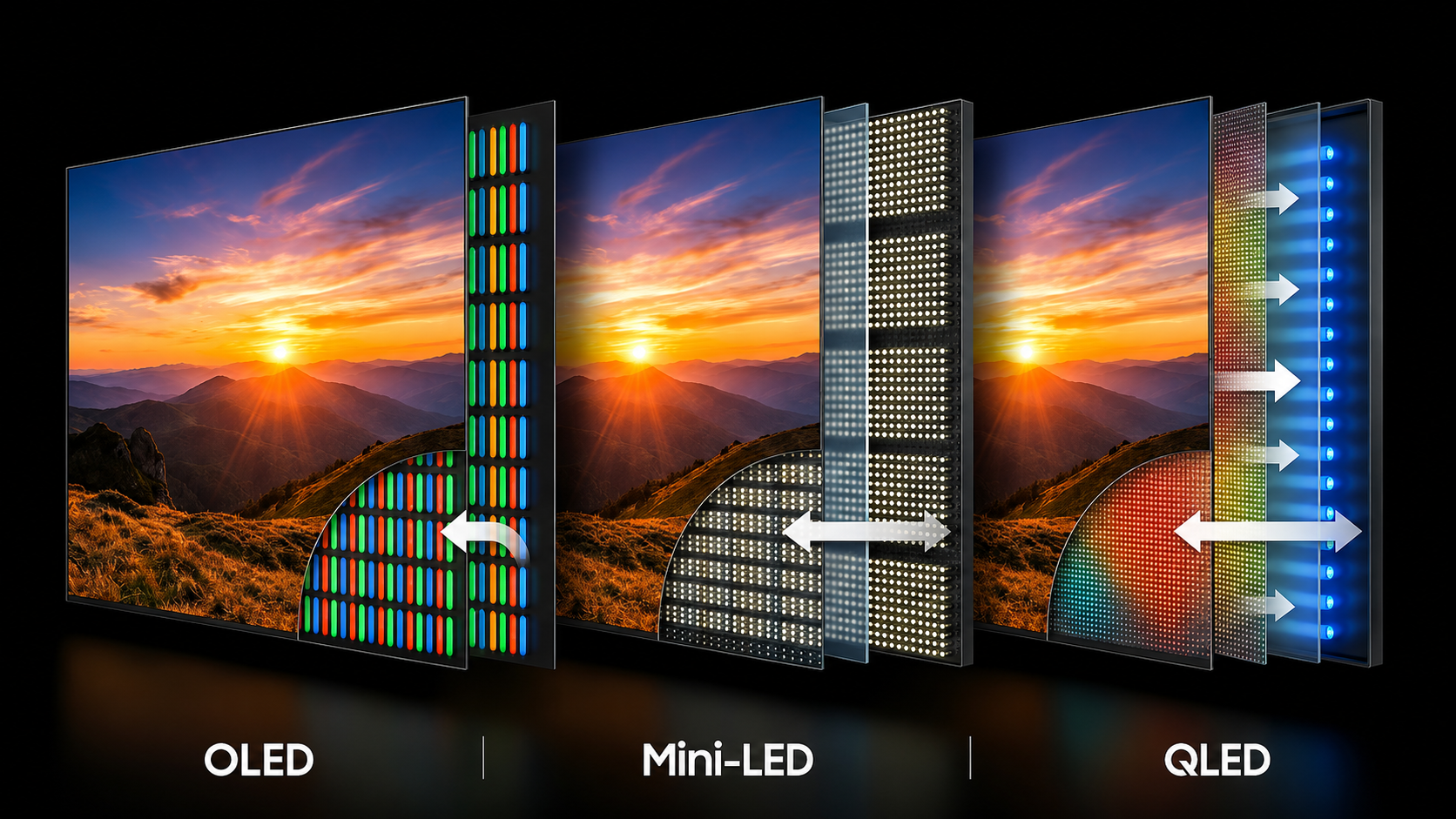
OLED or Mini LED – what to choose in 2026
This is one of the most common questions when buying a new TV. And it’s no wonder, as in 2026 both technologies are truly mature. OLED has long been associated with cinematic blacks, great contrast, and a premium picture. Mini LED, on the other hand, has gained huge popularity thanks to its high brightness, powerful HDR, and increasingly better backlight control. The problem is that it is very easy to get lost in marketing and buy a TV not for your own conditions, but for a trendy slogan.
That is why in this guide we will not answer with the slogan "it depends", but we will specifically show when it is better to choose OLED, when Mini LED, and when the difference is smaller than it seems at first glance. We will base this on real models from the Prestige TV offer, not on theoretical examples. This will make it easier for you to translate technology into a real purchase.
If you are in the stage of choosing a specific TV, also take a look at the text Which 55-inch TV to buy. If, on the other hand, after choosing a model you want to improve the picture further, we also recommend Does TV calibration make sense.
How OLED works
Simply put, OLED does not need a classic backlight behind the screen. Each pixel illuminates independently and can be completely turned off. This is why OLED is so prized in home cinema: if a scene is supposed to be black, the pixel can simply not light up. The effect is a very deep black, a strong sense of contrast, and a very clear image in darker scenes.
In practice, this produces an image that many people find more "calm," more natural, and more cinematic. OLED is especially appreciated when you are watching in the evening, with dimmed light, or if you like movies with a lot of dark scenes, high-contrast shots, and a strong atmosphere.
An additional plus is the very wide viewing angles. If you often watch TV from several places in the living room, not just directly in front, OLED will usually be a very comfortable choice.
How Mini LED works
Mini LED is still a TV with a backlight, but it is much more advanced than in classic LED designs. Instead of larger diodes and limited light control, you get much smaller LEDs, grouped into a larger number of dimming zones. Thanks to this, the TV can better dim dark parts of the picture and boost bright elements of a scene more strongly.
The biggest advantage? Brightness. That is why Mini LED works so well in bright rooms, when watching during the day, in sports, broadcasts, and everywhere where a strong, clear picture matters. Many people also immediately see the advantage of Mini LED in impressive HDR – bright elements of a shot can look very impressive.
In other words: if OLED impresses with black levels and the "silence" of the picture, Mini LED impresses with energy, dynamics, and light headroom.
OLED vs Mini LED – comparison table
| Criterion | OLED | Mini LED |
|---|---|---|
| Blacks and contrast in a dark room | Very strong point | Very good, but depends on dimming zones |
| Brightness during the day | Good to very good | Usually higher |
| HDR effect | Great, more cinematic | Great, often more "spectacular" |
| Viewing angles | Very wide | Usually weaker than in OLED |
| Evening movies | Usually wins | Very good, but not always as cinematic |
| Bright living room | Good solution with a good model | Often the best choice |
| Sports and everyday TV | Very good | Very good, often an advantage in brightness |
| Gaming | Great response time and strong contrast | Great brightness, strong HDR, and high refresh rate |
| For whom | For cinephiles and those sensitive to black quality | For bright living rooms, sports, and those looking for strong HDR |
Which is better for movies and evening viewing
If you care primarily about movies and series watched in the evening, the answer is usually: OLED. Here, the way blacks are built plays the biggest role. In a darker room, the difference can be very clear. Black does not look like dark gray, and the picture has more depth. This is why customers looking for a home cinema so often end up with an OLED.
In the Prestige TV offer, this division is clearly visible. If you are looking for a reasonably priced entry into OLED, you can look at the LG 55B56LA. If you want a very strong, universal level, natural steps are the LG 55C51 and Samsung QE55S90F. And if you are aiming for a higher shelf, it is worth looking at the Samsung QE55S95F, LG 55G56LS, and Philips 55OLED910.
Does this mean that Mini LED is not suitable for movies? Absolutely not. It’s just that if the priority is the atmosphere of a cinema and evening screenings, OLED will most often be more satisfying for a demanding viewer.
Which is better for a bright living room
In a bright living room, the situation often reverses and then a very strong argument appears on the side of Mini LED. Higher brightness makes the TV cut through daylight, brighter walls, and large windows better. The picture is clearer, and HDR can give a very strong, dynamic impression.
If the TV is to be used mainly during the day, for everyday watching, sports, and bright series, it is reasonable to start with Mini LED. At Prestige TV, great examples of this approach are the Samsung QE55QN85F, Samsung UE55M80H, Hisense 55U77S Pro, Sony K55XR55BP, and Panasonic TV55W95BEG.
This does not mean that OLED will not work in a bright room. A well-chosen OLED can still look great. It’s just that if the priority is the most legible and bright picture during the day, Mini LED usually provides greater comfort.
Which is better for gaming and sports
Here we must be honest: both technologies can be great, but for different reasons. OLED provides a very fast response time and great motion clarity, which is especially liked by gamers and people sensitive to picture fluidity. Mini LED responds with greater brightness and a very strong, spectacular HDR, which looks excellent in many games.
Therefore, the choice for gaming depends on the style. If you want a more "cinematic-gaming" picture, you will often be delighted by OLED – for example, the LG 55C51, Samsung QE55S90F, Samsung QE55S95F, or LG 55G56LS. If you play a lot during the day, like a very bright, high-contrast picture, and care about strong HDR and high refresh rates, Mini LEDs perform very interestingly, especially the Hisense 55U77S Pro, Samsung QE55QN85F, or Samsung UE55M80H.
For sports, Mini LED is sometimes chosen more often, because in typical daytime watching of matches, races, or live events, brightness simply makes a difference. On the other hand, if you watch sports in the evening and care about a clear picture with good contrast and wide angles while sitting with friends, OLED can also be a great choice.
Which models from the Prestige TV offer to choose
Choose OLED if:
- you watch mainly in the evening,
- you care about very good blacks and a cinematic effect,
- viewers sit at different angles,
- you are looking for a more "premium" movie and series experience.
In practice, start with: LG 55B56LA, LG 55C51, Samsung QE55S90F, Philips 55OLED820. If you want to go higher, look at the Samsung QE55S95F, LG 55G56LS, and Philips 55OLED910.
Choose Mini LED if:
- the TV sits in a bright living room,
- you watch a lot during the day,
- you like strong HDR and a bright picture,
- the TV will be frequently used for sports, broadcasts, and gaming.
In practice, start with: Samsung QE55QN85F, Samsung UE55M80H, Hisense 55U77S Pro, Sony K55XR55BP, and Panasonic TV55W95BEG.
And what to choose in 2026 if you just want the best compromise?
If you don't have an extremely bright living room and want a picture that makes an impression from the first launch, it is very hard to pass by the mid- and high-end OLEDs. However, if the TV is to serve the whole family from morning to night, often with a large amount of light, Mini LED remains a very reasonable solution and in many homes simply more convenient for everyday use.
Summary
In 2026, there is no single technology that is best for everyone. OLED wins when you are looking for blacks, contrast, wide angles, and a heavily cinematic picture character. Mini LED wins when brightness, everyday comfort in a bright living room, very spectacular HDR, and versatility for all-day viewing matter.
If you want a simple shortcut: for cinema – more often OLED, for a bright living room – more often Mini LED. But the final choice should always be based on specific models. Therefore, after reading this guide, I recommend going straight to the OLED or MiniLED collection, or checking out the 55-inch TV list.
FAQ
Does OLED provide a better picture than Mini LED?
For evening cinema and blacks, very often yes. For a bright living room and highly bright HDR, in many cases, Mini LED will work better.
Is Mini LED the same as OLED?
No. OLED uses self-illuminating pixels, while Mini LED uses advanced backlighting and many zones of local dimming.
What is better to choose for a very bright room?
Most often Mini LED, because it provides higher brightness headroom and usually handles everyday daytime viewing better.
What is better to choose for movies in the evening?
Most often OLED, especially if you care about the deepest possible blacks and a more cinematic picture.
Is OLED suitable for gaming?
Yes, and very well so. Modern 120 Hz, 144 Hz, and 165 Hz OLEDs are some of the best TVs for consoles and PC.
Is Mini LED good for sports?
Yes. High brightness and a very clear picture during the day make Mini LED often a great choice for sports and broadcasts.
Which OLED and Mini LED models are worth checking out at Prestige TV?
For OLED, it is worth seeing the LG 55C51, Samsung QE55S90F, Samsung QE55S95F, or Philips 55OLED910. For Mini LED: Samsung QE55QN85F, Samsung UE55M80H, Hisense 55U77S Pro, Sony K55XR55BP, and Panasonic TV55W95BEG.
Udostępnij:
OLED vs. QLED – what are the differences and which TV to choose? A complete guide
Micro RGB, Mini LED, and LCD – what do these actually mean and which TV should you choose?