

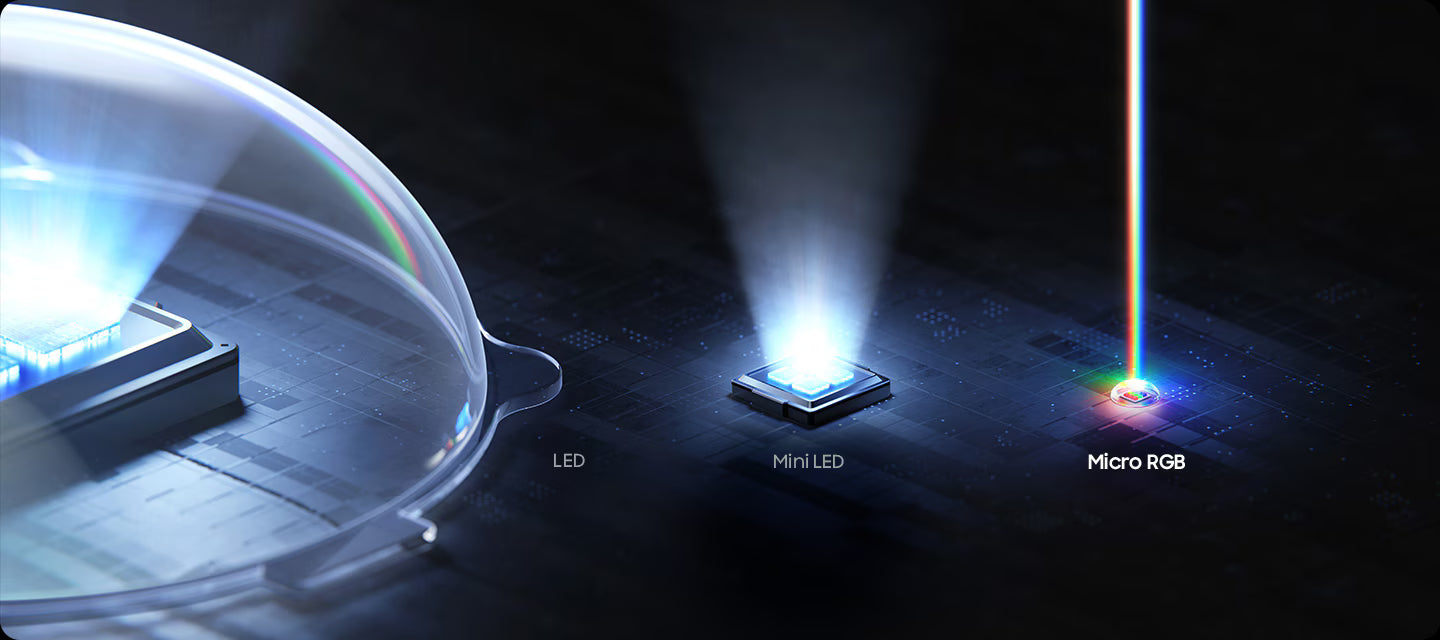
Micro RGB, Mini LED, and LCD – what does this actually mean and which TV should you choose?
If you are looking for a new premium TV, it is very easy to get lost in the terminology. Product descriptions feature terms like LCD, LED, Mini LED, RGB Mini LED, True RGB, or Micro RGB, and customers often hear several similar-sounding slogans without knowing what actually translates into image quality. In this guide, we break down the subject in simple language and show what these technologies mean in practice – without the marketing fog, but with a focus on real benefits for home cinema, sports, and gaming.
The most important information to start with is very simple: LCD is the foundation. A classic LED TV is, in practice, an LCD TV with LED backlighting. Mini LED is a more advanced variation of this solution, and modern RGB designs, such as Micro RGB or True RGB, go a step further by enhancing the way the image is backlit and how color is managed. In other words: we are not comparing three completely unrelated worlds. Rather, we are comparing three levels of LCD TV evolution.
Let's clarify the concepts first
When talking about televisions, customers very often use the words "LCD" and "LED" interchangeably. This is understandable, but technically speaking, it is not exactly the same thing. LCD stands for liquid crystal display, which is the layer that controls the passage of light and builds the image. LED refers to the way this matrix is backlit. Therefore, a standard "LED TV" is, from a structural point of view, simply an LCD TV with LED backlighting.
Subsequent generations of solutions were built on this foundation. First, classic LED/LCD, then designs with more advanced local dimming, and then Mini LED, where the backlight diodes are smaller and more numerous. Positioned even higher are the latest RGB variants, in which manufacturers begin to control red, green, and blue diodes separately, thereby improving not only brightness itself but also color purity and precision.
For the customer, this can be boiled down to a simple scheme:
- LCD / LED – basic, well-known TV technology.
- Mini LED – more advanced backlighting, better light control, stronger HDR, and higher image quality.
- Micro RGB / True RGB / RGB Mini LED – premium segment that manages light and color with even greater precision.
How LCD works and what an LED TV means
In a classic LCD TV, the image is not created because the pixels emit light themselves. Backlighting located behind the matrix is needed, and liquid crystals act as very fast "light valves" that allow more or less light through. This is precisely why LCD TVs can look very different depending on the quality of the backlighting, image processing, and color filters used.
In practice, this means several things. First, a classic LED/LCD can provide a very pleasant, bright image for daily TV viewing, sports, or VOD services. Second, it is a solution usually more affordable than higher premium series. Third, however, if you watch many movies in the evening and pay attention to contrast, black depth, and the "wow" effect in HDR, a standard LED/LCD will show its limitations sooner.
This does not mean that classic LCD is bad. It only means that it is the most basic point of reference. If the TV is to be used for daily news, linear channels, YouTube, and occasional movies, a regular LED/LCD can still be a reasonable choice. If, however, you expect a more cinematic and "premium" image, then Mini LED or RGB designs start to make real sense.
What is Mini LED and what does it offer in practice
Mini LED is still an LCD TV, but with a much more modern approach to backlighting. Instead of larger diodes, significantly smaller LED diodes are used, which can be placed more densely and controlled more precisely. In practice, this provides several benefits that the customer sees immediately upon turning on HDR content or watching a match in a bright living room.
The first benefit is higher brightness. Mini LED TVs handle sunlit rooms very well, where a weaker screen would fade faster. The second is better contrast, because the TV has more light control zones. The third is a more impressive HDR – reflections, city lights, flashes, sunlight, or the glow around objects can look clearer and more spatial. The fourth is, ultimately, a very good foundation for sports and gaming, especially in 120 Hz, 144 Hz, or 165 Hz models.
However, it is worth remembering one thing: Mini LED does not change the fact that we are still dealing with an LCD TV. This means that the black quality and dimming precision depend on the advancement of the backlighting system. The higher the model class, the better. Therefore, two Mini LED TVs do not have to look the same. A budget series and a premium series can differ very significantly.
For many customers, Mini LED is today the most reasonable middle ground between price, brightness, HDR effect, and versatility. It is a technology particularly worth noting if the TV is to be placed in a living room open to daylight, is to be used for sports and gaming, and at the same time is to provide a noticeable quality jump compared to classic LED/LCDs.
What are Micro RGB and RGB Mini LED
This is where the truly premium segment begins. In TVs described as Micro RGB, True RGB, or RGB Mini LED, manufacturers evolve the very idea of backlighting to control color and light even better. Simply put: instead of relying mainly on traditional backlighting and "filtering" colors, the TV works on a more advanced system of red, green, and blue diodes controlled very precisely.
In practice, the customer gains primarily cleaner colors, very high brightness, and more selective image control. This is a technology that makes sense when you are not just looking for a "good TV," but want to reach a higher level of image quality in a large living room, home cinema area, or a modern interior where the TV is to become the central element of the space.
It is worth emphasizing that manufacturers use various brand names here. Samsung is developing its Micro RGB line, Sony communicates its models as True RGB, and Hisense talks about RGB Mini LED. For the customer, however, the most important thing is not the slogan itself, but the sense of the technology: the image should be more saturated, more precise, and more impressive than in a classic Mini LED, especially if you watch 4K HDR content, sports, and games on a big screen.
This is also a segment for people who do not want to compromise typical of cheaper series. If you care about a flagship image character, a very large diagonal, strong brightness, and a high refresh rate, this is where the most exciting offerings begin.
Comparison table
| Technology | How it works | Strengths | Limitations | Who is it for | Examples from Prestige TV |
|---|---|---|---|---|---|
| LCD / LED | Liquid crystal matrix with classic LED backlighting. | Good price-to-performance for daily use, bright image, simple choice for TV and streaming. | Weaker contrast and less impressive HDR than in higher classes. | For those who want a solid 4K TV for daily viewing without entering the premium segment. | Samsung UE55U8092F 55" LED 4K |
| Mini LED | LCD TV with smaller backlight diodes and more precise local dimming. | Higher brightness, better contrast, stronger HDR, very good versatility for the living room, sports, and gaming. | It is still an LCD, so the final quality depends on the model class and backlight precision. | For customers who want a clear step up from regular LED/LCD. | Samsung QE55QN80F 55" QD-Mini LED, Samsung QE75QN85F 75" QD-Mini LED |
| Micro RGB / True RGB / RGB Mini LED | An advanced variation of a premium LCD TV where manufacturers control red, green, and blue backlight diodes very precisely. | Very high brightness, great color purity, strong HDR effect, premium segment, and large diagonals. | Higher entry cost, offer aimed mainly at more demanding customers. | For people building a premium home cinema, a large TV area, or looking for a flagship image for sports, movies, and gaming. | Samsung MRE65R86H 65" Micro RGB, Samsung MRE85R95H 85" Micro RGB, Sony BRAVIA 7 II K-55XR75M2, Sony BRAVIA 9 II K-85XR95M2, Hisense 65UR9S RGB Mini LED |
Who are LCD, Mini LED, and Micro RGB for
Choose classic LCD/LED if a reasonable budget, daily use, and a simple purchase without paying extra for premium solutions are your top priorities. This is a good choice for regular TV, series, YouTube, news programs, and occasional movie watching.
Choose Mini LED if you want a noticeably better image, watch a lot of sports, play on a console, or if the TV will be placed in a bright living room. This is currently a very strong balance point: the TV already has a "premium" character but does not yet enter the highest price bracket.
Choose Micro RGB or RGB Mini LED if you want to fully exploit the potential of a large screen, watch a lot of 4K HDR movies, care about visual spectacle, and do not want to cut corners. This segment is for customers who know that a TV is to be more than just a screen in the living room – it should make an impression every time you start a movie, match, or game.
If you want to take a broader look at the entire offer, see also TVs available at Prestige TV and our collection of 4K TVs. If you are concerned about selecting equipment for a specific interior, it is also worth consulting the choice with an advisor – especially with larger diagonals and more advanced series.
Example models available at Prestige TV
To not leave you with just theory, below we show a few specific purchase directions based on models available in the store.
If you are interested in entering the world of Micro RGB, a very good starting point would be the Samsung MRE65R86H 65" Micro RGB. This is a proposal for a customer who wants to see what the newer generation of premium imaging looks like without having to jump into the largest diagonals right away. If you care about a larger scale and an even higher class, check out the Samsung MRE85R95H 85" Micro RGB.
If you want to bet on premium RGB by Sony, pay attention to the SONY BRAVIA 7 II K-55XR75M2 55" and the flagship SONY BRAVIA 9 II K-85XR95M2 85". The first will be great where the balance between image class and size matters; the second is a TV for those who are building a full-fledged home cinema.
If you are curious about RGB Mini LED from Hisense, see the Hisense 65UR9S 65" RGB Mini LED. This is an interesting direction for a customer looking for very strong image specifications and refresh rates in a modern, large TV.
If you care about a reasonable Mini LED, and not necessarily the top RGB shelf right away, check out the Samsung QE55QN80F 55" QD-Mini LED. This is a good example of a TV that provides a noticeable jump compared to a classic LED/LCD and fits very well into a multi-tasking living room.
If you just want a good, classic LCD/LED TV, without entering into higher technologies, a natural point of reference would be the Samsung UE55U8092F 55" LED 4K. Such a model still makes sense if your priority is daily convenience, not a race for the most advanced image solutions.
If you don't know where to start, contact us through the form and contact details of Prestige TV. With premium TVs, it is really worth matching the model to the living room conditions, distance from the screen, and the type of content being watched.
What to look for before buying
When choosing a TV, don't look only at the technology name. The whole package matters. Even the best technology will yield different effects depending on the class of the image processor, refresh rate, HDR quality, anti-reflective coating, audio system, and screen size.
If you watch mainly in the evening, pay attention to contrast and light control. If you have a very bright living room – to brightness and resistance to reflections. If you play – to 120 Hz or more, HDMI 2.1, VRR, and input lag. If you watch sports – to motion fluidity and image stability in fast shots. And if the TV is to be a design element, it is worth considering the design and mounting method as well.
The good news is that you will find TVs from each of these levels in the Prestige TV offer today: from classic LED/LCD, through powerful Mini LED, to the latest Micro RGB and True RGB designs. Therefore, instead of asking only "which is the best?", it is better to ask: which will be the best for my living room and my content?
If you want the shortest answer, it goes like this:
- LCD/LED – good choice for daily viewing and a reasonable budget.
- Mini LED – very good choice for most demanding customers.
- Micro RGB / RGB Mini LED / True RGB – premium choice when you want maximum effect and modern image quality.
FAQ
Is an LED TV the same as an LCD?
In retail practice, it is very often simplified that way. Technically, an LED TV is an LCD TV with LED backlighting. LCD describes the matrix itself, and LED describes the way it is backlit.
Is Mini LED a new matrix or just better backlighting?
Mini LED is still an LCD TV, but with much more advanced backlighting. Thanks to smaller diodes and better control of light zones, the image is brighter, has more contrast, and handles HDR better.
How does Micro RGB differ from Mini LED?
Micro RGB and related premium RGB solutions go a step further than classic Mini LED. Their goal is to control light and color even more accurately through very precise operation of red, green, and blue diodes.
What to choose for a bright living room?
For a bright living room, Mini LED TVs and premium RGB designs usually work best because they offer high brightness and a stronger HDR effect.
What to choose for movies, sports, and games on a big screen?
If you want a powerful cinematic scale and very high image quality, it is worth looking towards premium-class Mini LED or Micro RGB / True RGB / RGB Mini LED. This is a particularly good direction for customers choosing large screen sizes and high refresh rates.
Udostępnij:
OLED or Mini LED – what to choose in 2026
Micro RGB vs. Primary RGB Tandem OLED – which TV technology is better?